Lab Environment
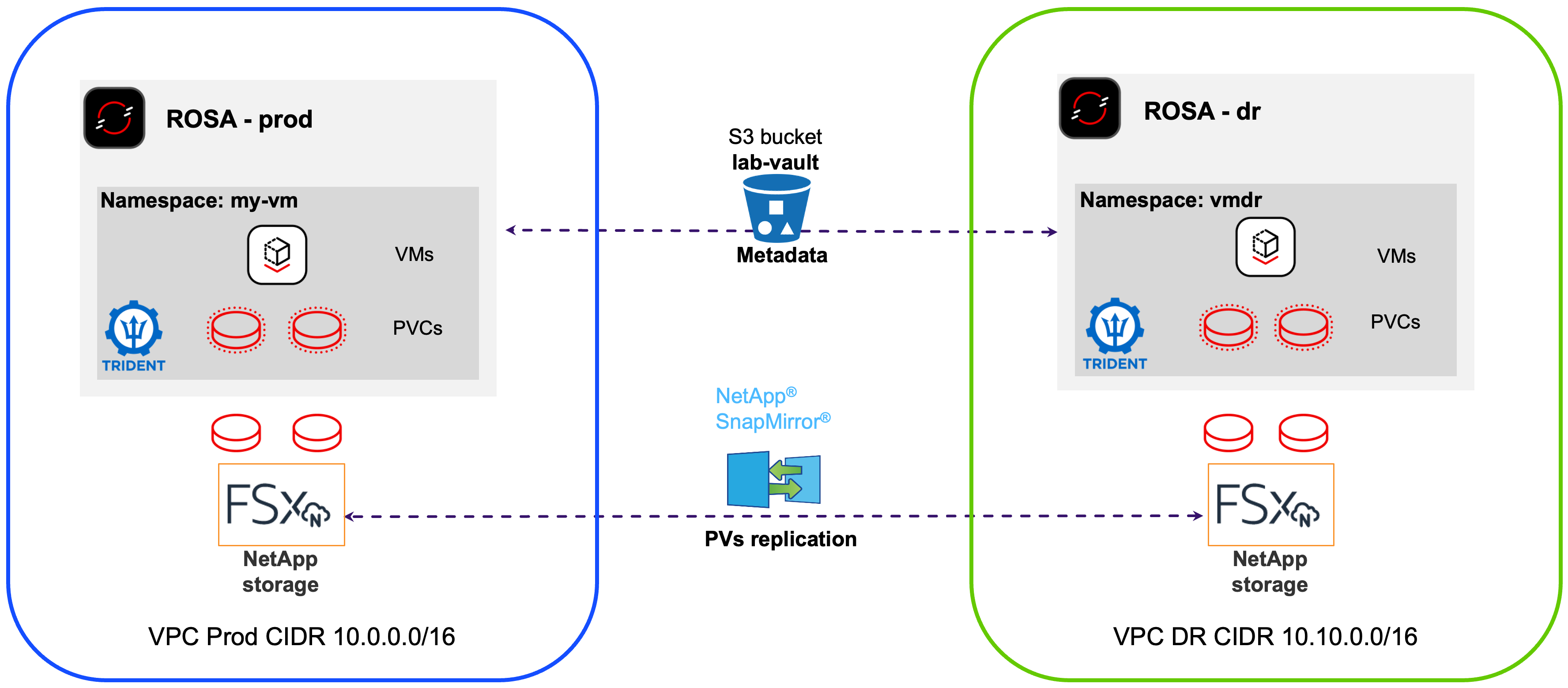
The lab environment consists of the following components:
Cluster and Networking Configuration
-
OpenShift Clusters (ROSA): Two Red Hat OpenShift Service on AWS (ROSA) clusters, named prod and dr, both running OpenShift 4.18.
-
Networking (VPCs): Each ROSA cluster resides in its own VPC within a single AWS account.
-
prod VPC CIDR:
10.0.0.0/16 -
dr VPC CIDR:
10.10.0.0/16
-
-
VPC Peering: A VPC peering connection is configured between both VPCs to allow replication traffic.
-
Security: Route tables and Security Groups are updated to allow replication traffic in both directions.
Storage and Replication
-
Storage: Each VPC contains an FSx for NetApp ONTAP file system.
-
Connectivity: Security Groups are configured to allow connectivity between the ROSA cluster and its respective FSx file system.
-
Storage Virtual Machine (SVM): Inside each FSx file system, a dedicated SVM has been created for OpenShift use.
-
Replication: The replication technology used by Trident Protect is NetApp SnapMirror.
-
SnapMirror efficiently replicates delta snapshots asynchronously between the SVMs of the two FSx file systems.
-
FSx file systems and their respective SVMs are already peered to facilitate replication.
Deployment Status & Tasks
-
AWS S3 Bucket: An S3 bucket is already created and used by Trident Protect as the destination for data and metadata backups.
-
Prod Cluster Status: Trident and Trident Protect are already installed and configured in the prod ROSA cluster.
-
Your Deployment Tasks:
-
Deploy and configure Trident in the dr ROSA cluster.
-
Deploy and configure Trident Protect in the dr ROSA cluster.
-