Appendix: advisory change detection
This optional reference is for instructors and automation authors. It shows how the supplied polling helper can detect a change in an OSV repository manifest. The core workshop uses the local sample advisory in module 2.2 and does not require live polling.
Understand the signal
The helper requests PULP_MANIFEST from a configured OSV base URL and compares its SHA-256 checksum with a saved value. A changed checksum tells you that the manifest changed. It does not identify an applicable fix, verify an advisory’s authenticity, or authorize a production deployment.
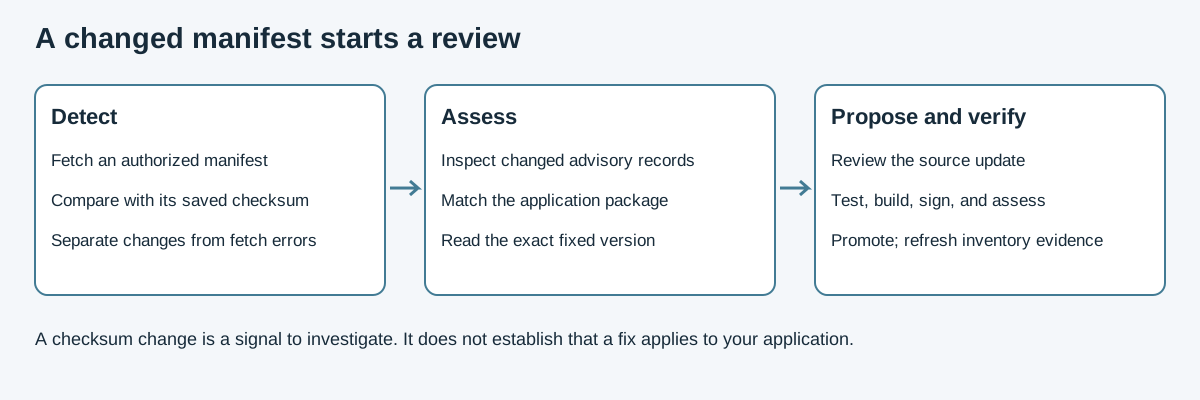
Use a reachable repository that actually serves this manifest and for which you have access. The seeded Nexus sample documents do not establish that a live manifest is available. The configured Java OSV reference is https://packages.redhat.com/lightwell/osv/java/remediated; confirm the endpoint and access requirements before using it in customer automation.
Inspect the supplied helper
The application template includes tools/osv-eval/scripts/poll-pulp-manifest.sh. In the existing Showroom application clone, inspect it before running it. If the file is absent, use this appendix as a design reference rather than attempting commands from another repository.
cd /home/lab-user/lightwell-workspace/spring-boot-lw-poc
test -f tools/osv-eval/scripts/poll-pulp-manifest.sh
sed -n '1,180p' tools/osv-eval/scripts/poll-pulp-manifest.sh
The helper requires Bash, curl, sha256sum, and standard shell utilities. It reads optional credentials from LW_USERNAME and LW_PASSWORD; keep those out of source and shared output. Its optional webhook path also requires Python, but the example below leaves notifications disabled.
Optional: run one comparison
Enter the authorized repository’s OSV base URL. Use a separate state directory for each source so checksums from unrelated repositories are never compared. Run from a terminal where the required network access and credentials are already configured.
read -r -p 'Authorized OSV base URL: ' OSV_BASE
export OSV_BASE
export STATE_DIR="$HOME/.cache/lightwell-osv-review"
WEBHOOK_URL='' INTERVAL_SEC=0 bash tools/osv-eval/scripts/poll-pulp-manifest.sh
POLL_STATUS=$?
printf 'Polling exit status: %s\n' "$POLL_STATUS"| Observation | Meaning |
|---|---|
First successful request, exit 0 |
The helper saves a baseline checksum. This is initialization, not a newly discovered remediation. |
|
The fetched manifest matches that baseline. |
Changed-content message, exit 2 |
The helper updates the stored checksum and reports a change. Treat exit 2 as a change signal when integrating this script into automation. |
Fetch or execution error |
There is no usable comparison. Inspect the error and repair access or tooling before retrying. |
The helper’s first-20-lines output is a preview, not a diff of added records. For reliable automation, retain previous manifests, compare entries, and preserve a processing record. The helper updates its checksum before an optional notification; it is not a durable work queue.
Review before proposing an update
-
Retrieve the changed advisory through the approved source.
-
Match its package identity to a dependency in your application inventory.
-
Read the relevant affected range and exact fixed version, as in 2.2.
-
Propose the source change for review and run application tests.
-
Build, sign, and evaluate the resulting image before GitOps promotion.
-
Refresh the inventory and advisory assessment for the promoted digest.
Schedule polling and connect notifications only after defining ownership, retry behavior, authentication, and duplicate-event handling. This appendix does not configure a scheduler, create tickets, or trigger builds.