2.2 Select and verify the remediated dependency
You have configured Maven to use Nexus and recorded Commons Lang 3.14.0 in the dependency tree. Now read the workshop advisory, select the exact version containing its fix, and confirm that Maven resolves that version through Nexus Remediated. Continue in the same ~/lightwell-dependencies clone from module 2.1.
Why this control exists
A security backport lets an application remain on its existing release line while adopting a fix. The exact Lightwell version includes a suffix such as .rhlw-00001. You select that version from the advisory for the matching package, then record it in the application’s default dependency property.
OSV is a JSON vulnerability-record format. Its affected entries identify packages and version ranges; a fixed event names a version containing the fix. This exercise uses LW-DEMO-0002, a workshop sample rather than a real CVE. The sample marks Commons Lang 3.14.0 affected and names a backport as fixed. Resolving the sample demonstrates version selection, not an independent security assessment.
Learning objectives
By the end of this module, you will be able to:
-
Match the Maven package in an OSV record to the dependency in your POM.
-
Set the default dependency property to the record’s exact
fixedversion. -
Compare the original and remediated dependency trees and identify the Nexus download source.
-
Carry the selected version forward to your application source in Track 3.
Read the advisory for your dependency
The starter’s advisories/LW-DEMO-0002.json is imported from the same canonical fixture that provisioning uses for Nexus. WORKSHOP_REVISION records its source revision. You do not need to extract another copy from a ConfigMap.
Check that the record’s package name matches org.apache.commons:commons-lang3 in your POM. Find the fixed event under that package’s ranges and record its exact value. Do not select a version from an unrelated package.
cd ~/lightwell-dependencies
cat advisories/LW-DEMO-0002.json
cat pom.xml
You can also inspect the same file in Gitea: open workshop-templates/lightwell-dependencies, then advisories → LW-DEMO-0002.json. In the screenshot, the package name identifies Commons Lang and the fixed event names the exact version to select. Read your cloned file for the exercise; the screenshot is a navigation aid.
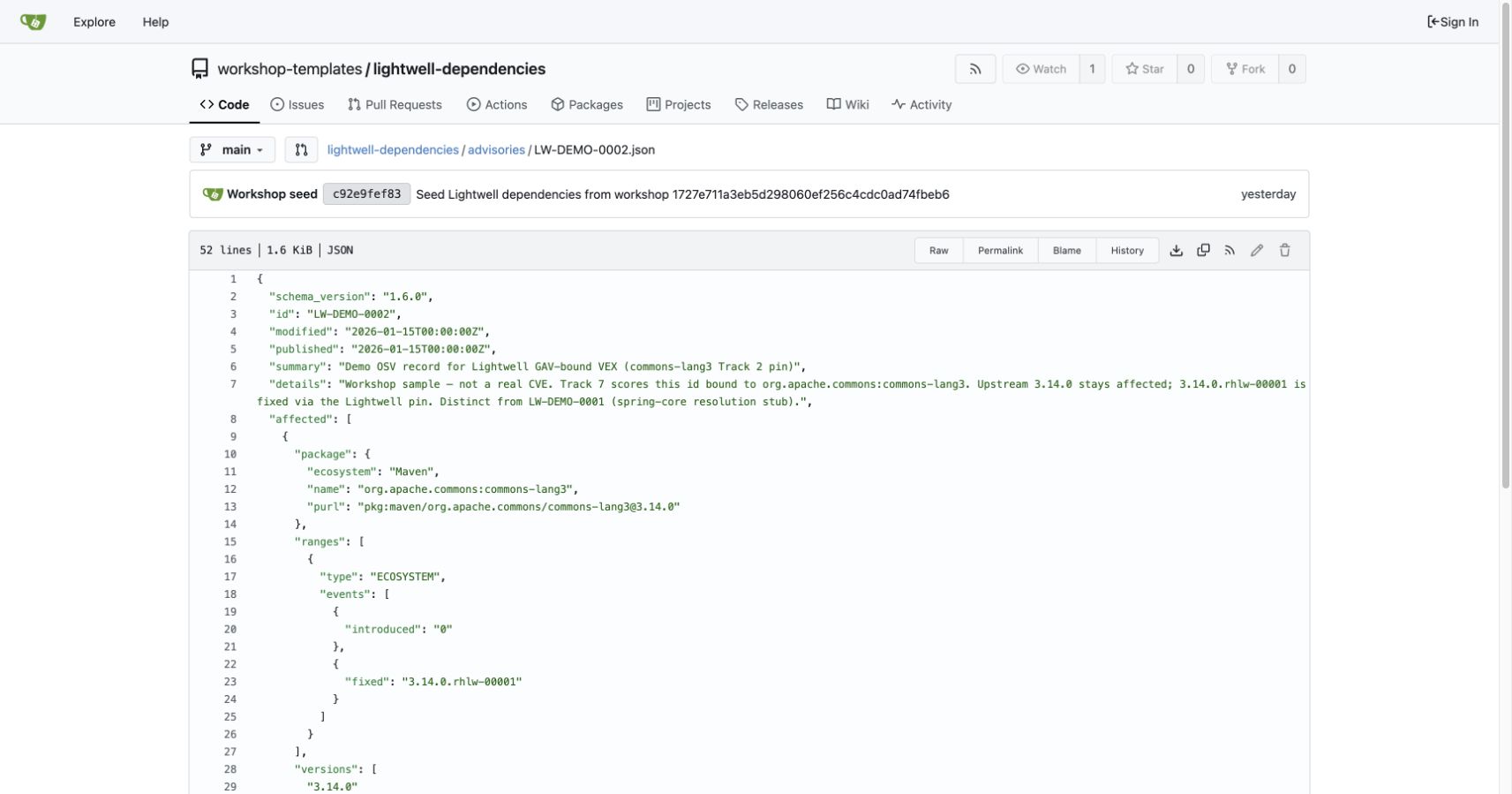
Use the advisory’s fixed version as the value of <commons.lang3.version>. The dependency’s <version> refers to that property. Changing the default property makes the selected version apply without an additional version override. The Remediated profile in settings selects a repository; it does not change this property.
|
In a seeded claim, |
Exercise
Open ~/lightwell-dependencies/pom.xml in your terminal editor. Replace the default <commons.lang3.version> value with the exact fixed value you read. Keep the group and artifact unchanged.
The POM diff should show one changed line: the default version moves from 3.14.0 to 3.14.0.rhlw-00001. A newer upstream release is a different coordinate from this exercise’s simulated backport.
cd ~/lightwell-dependencies
git --no-pager diff -- pom.xml
Resolve the remediated version
Use the same settings file, select the Remediated profile, and capture another fresh-cache run. The separate cache makes the artifact’s download source visible. Maven plugins may still come from Central; this exercise checks the Commons Lang artifact.
The resolve goal downloads the dependency JAR; tree alone may fetch only its POM. Require a download line ending in the selected .jar, not just .pom.
When the command completes, check that its exit status is zero and the dependency tree contains org.apache.commons:commons-lang3:jar:3.14.0.rhlw-00001. A Downloaded from lightwell-java-remediated line should show this artifact coming from your Nexus URL.
cd ~/lightwell-dependencies
mkdir -p evidence
AFTER_DIR="$(mktemp -d "$PWD/evidence/remediated.XXXXXX")"
printf '%s\n' "$AFTER_DIR" > evidence/current-after
mvn -B -s settings.xml -f pom.xml \
  -Dmaven.repo.local="$AFTER_DIR/m2" -Plightwell-remediated \
  org.apache.maven.plugins:maven-dependency-plugin:3.7.0:resolve \
  org.apache.maven.plugins:maven-dependency-plugin:3.7.0:tree \
  > "$AFTER_DIR/maven.log" 2>&1
MAVEN_STATUS=$?
cat "$AFTER_DIR/maven.log"
printf 'Maven exit status: %s\n' "$MAVEN_STATUS"
Review
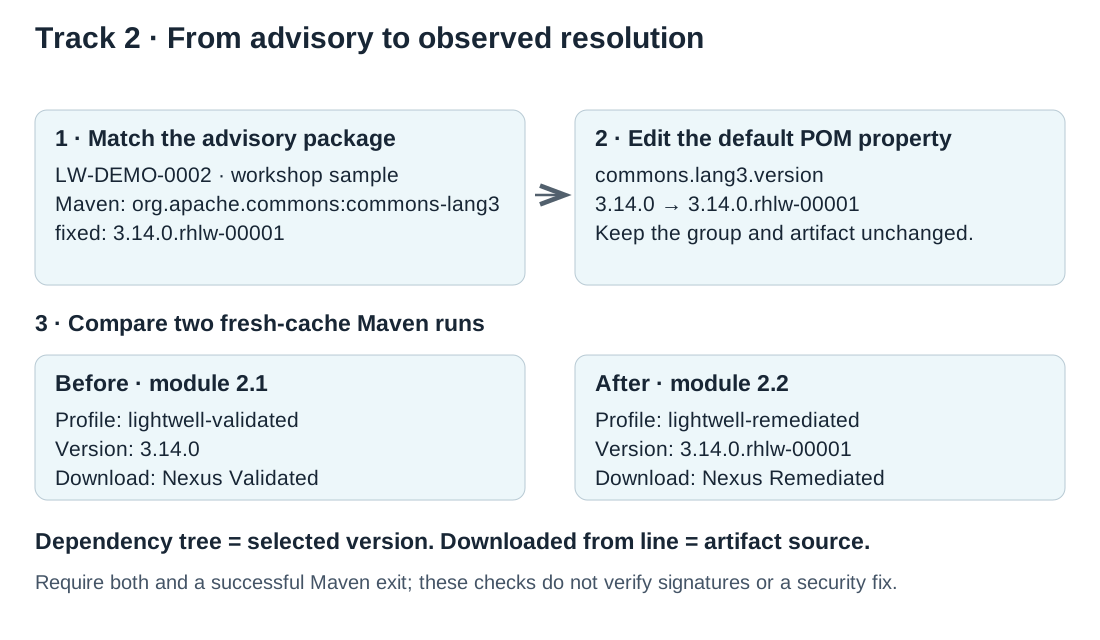
Stop and investigate a nonzero Maven status. Compare the saved logs from both modules. Success is the original version in the first tree and the exact advisory version in the second, with successful downloads from the corresponding Nexus channels.
cd ~/lightwell-dependencies
BEFORE_DIR="$(cat evidence/current-before)"
AFTER_DIR="$(cat evidence/current-after)"
grep -E 'Downloaded from .*commons-lang3|org.apache.commons:commons-lang3:jar:' "$BEFORE_DIR/maven.log"
grep -E 'Downloaded from .*commons-lang3|org.apache.commons:commons-lang3:jar:' "$AFTER_DIR/maven.log"
git --no-pager diff -- settings.xml pom.xml
If the baseline is missing, return to module 2.1 and capture the original version before repeating this comparison. Preserve existing evidence directories. On a repeated run with an existing cache, Maven may omit download lines; the fresh-cache commands above avoid that ambiguity.
You have three related observations: the advisory names the fix, Git shows your property change, and Maven shows the selected version and its source. There is no validation Job. The dependency tree does not prove a signature or independently establish that a vulnerability is fixed.
Carry the result into Track 3
Keep your settings, edited POM, and evidence in Showroom. In Track 3.2, apply the selected version to the default property in your own application’s POM. Do not replace that application’s POM with this small exercise POM. Track 3 commits the change to your student-owned Gitea repository. In a later exercise, Renovate opens a pull request to update the dependency version and base-image digest recorded in lightwell-pins.properties. Track 7 uses the sample’s GAV-bound VEX evidence.
|
Python expresses an exact Lightwell version with a |
Official documentation
For customer delivery, see Verify supplier provenance for a real Java dependency. That separate control checks a real JAR against its supplier bundle and trusted key; the seeded fixture makes no such provenance claim.