Workshop Overview
Learning objectives
By the end of this section, you will be able to:
-
Describe what Fed Aura Capital is and why it rebuilt its AI platform
-
Explain the CTO’s four-phase platform rebuild and the problems each phase solved
-
Identify the persona-based agent architecture that powers Lenora, the AI assistant for mortgage lending
-
Navigate the workshop’s structure and understand how sections connect
What is this workshop about?
Traditional AI demos show a model answering questions. Production AI requires a complete platform: model serving, governed access, domain grounding, tool integration, observability, evaluation, and security. Each capability solves a real business problem, and they must work together.
This workshop takes you through the Red Hat AI product portfolio by putting you in the shoes of a newly joined engineer at Fed Aura Capital. The AI platform is already running, and your job is to get up to speed on every layer of it. Each section introduces a capability, shows you what Fed Aura Capital’s setup looks like in practice, and gives you hands-on time with the same tools. By the end, you’ll know why the platform looks the way it does and what each component contributes.
Meet Fed Aura Capital
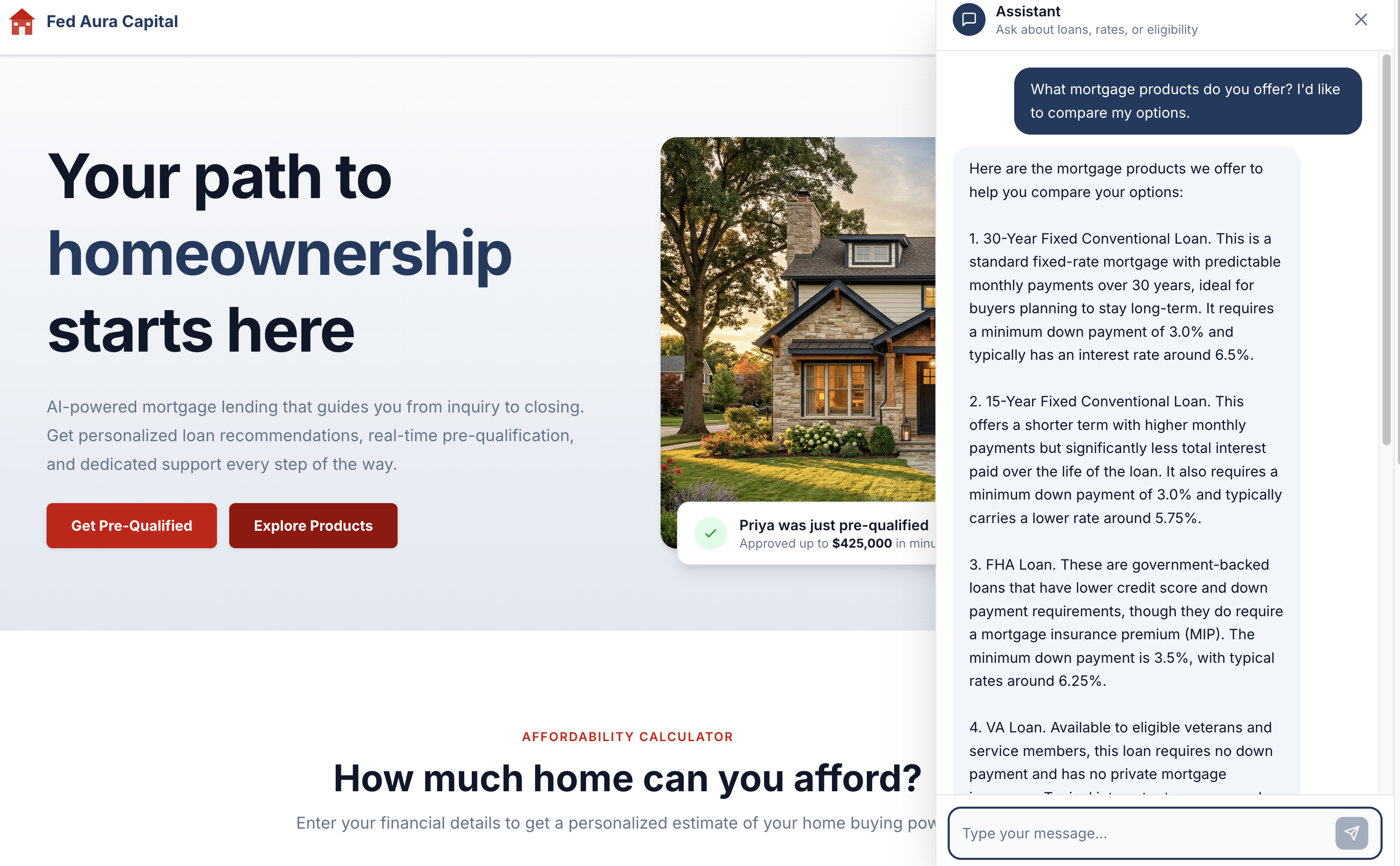
Fed Aura Capital is one of the largest fictitious banks in the country. Over the last year, the company deployed an AI-powered customer assistant named Lenora to support borrowers, loan officers, underwriters, and executives throughout the mortgage lifecycle.
Lenora started as a prototype chatbot connected to an external model. Today, she is a production-grade AI system running entirely on Red Hat AI with self-hosted models, domain-grounded knowledge, tool-calling agents, full observability, and defense-in-depth security.
Your first day: the CTO briefing
As part of your onboarding, your team shares a link to a recorded all-hands from six months ago - the kickoff where your CTO announced the platform rebuild. You hit play.
When we started, Lenora was a chatbot connected to an external inference API. Every borrower (customer) question left our network, costs scaled with every conversation, and we had no control over what the model knew or how it behaved. Regulators started asking questions: Where is customer data processed and stored? Can the API provider use it to train its models? Who can access sensitive financial information? Can we trace and explain the answers given to customers? Our CISO blocked production deployment. We had to rethink the whole thing.
We rebuilt the platform in four phases. First, we took control of our own inference - deployed models on our own infrastructure, stopped paying per-token, and exposed them as a managed service. Second, we made the AI actually useful - gave it our policies, our products, our data. Third, we connected it to real tools and made every decision traceable. Fourth, we locked it down: guardrails, adversarial testing, sandboxed agents, full audit trail.
Each of these phases solved a real problem.
Your job: Work through each of those four pillars throughout this workshop and understand the platform well enough to support it.
What’s next
Now that you understand the mission, the next page introduces the platform you will be working with: the four transformation pillars, the agent personas, and the architecture. After that, Explore the Platform gives you your first hands-on exercises with Lenora.