Tools and MCP
Lenora called five tools in her risk assessment. Those tools did not come from the LLM. They came from external servers that the platform connected her to through a standard protocol called MCP.
MCP (Model Context Protocol) is an open standard that defines how AI agents discover and call external tools. Before MCP, connecting an agent to a tool meant hardcoding the tool’s definition into the agent’s code, so every agent had to know about every tool it might ever use. MCP changes this: any agent that speaks the protocol can connect to any server that speaks it, without any custom integration code. Think of it like USB for AI tool access, a universal connector that works regardless of what is on either end.
The platform hosts an MCP gateway that registers tool servers centrally. Agents connect to the gateway, the gateway routes calls to the appropriate server, and the results come back through the same channel. Adding a new tool means either adding it to an existing server or registering a new one with the gateway, with no changes to any agent.
Exercise 3: Explore the MCP Catalog
-
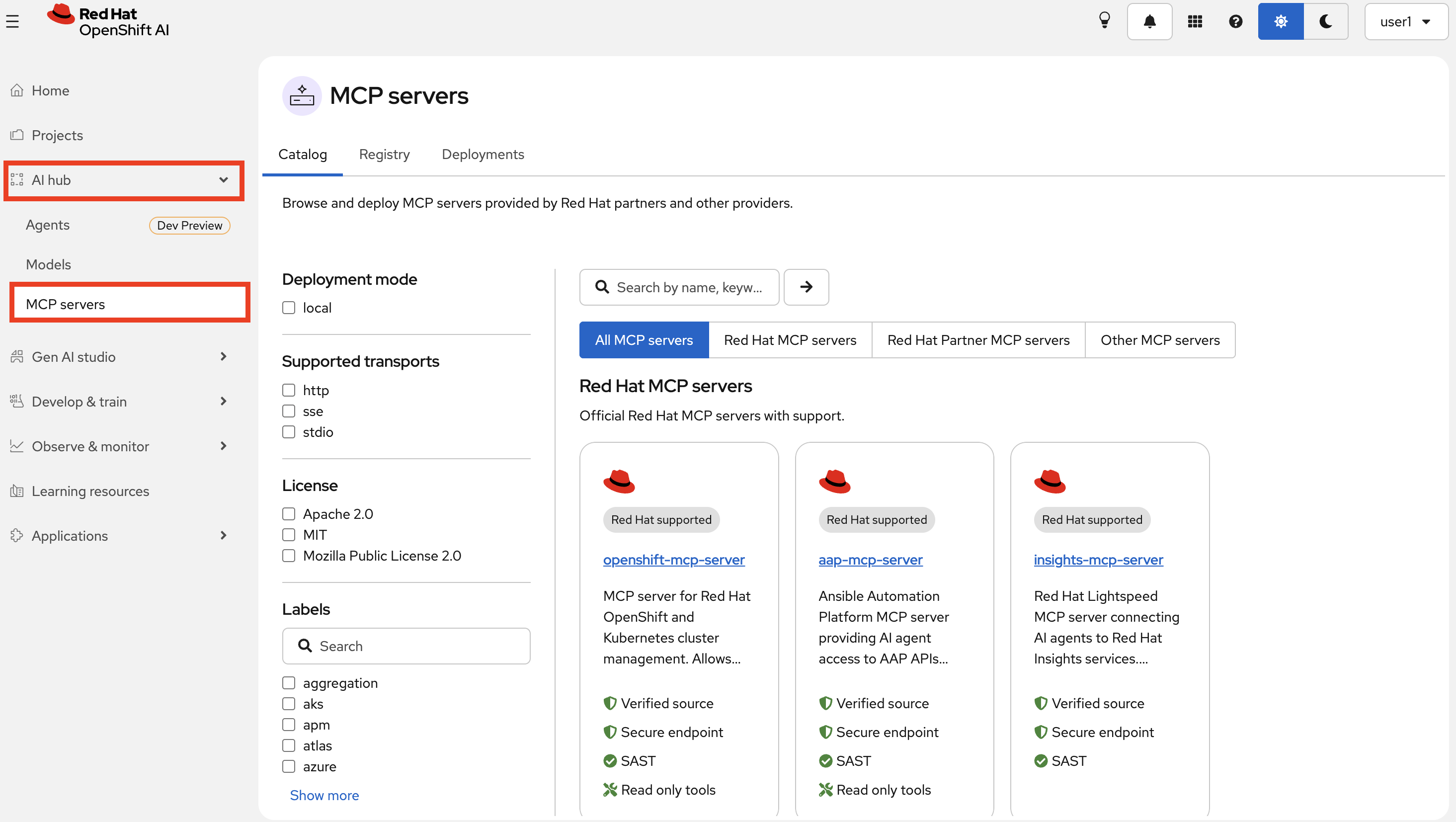
Navigate to AI Hub > MCP Servers and observe catalog tab:
-
You will see a catalog of available tool servers, some built by Red Hat, and some from the broader partner ecosystem.
-
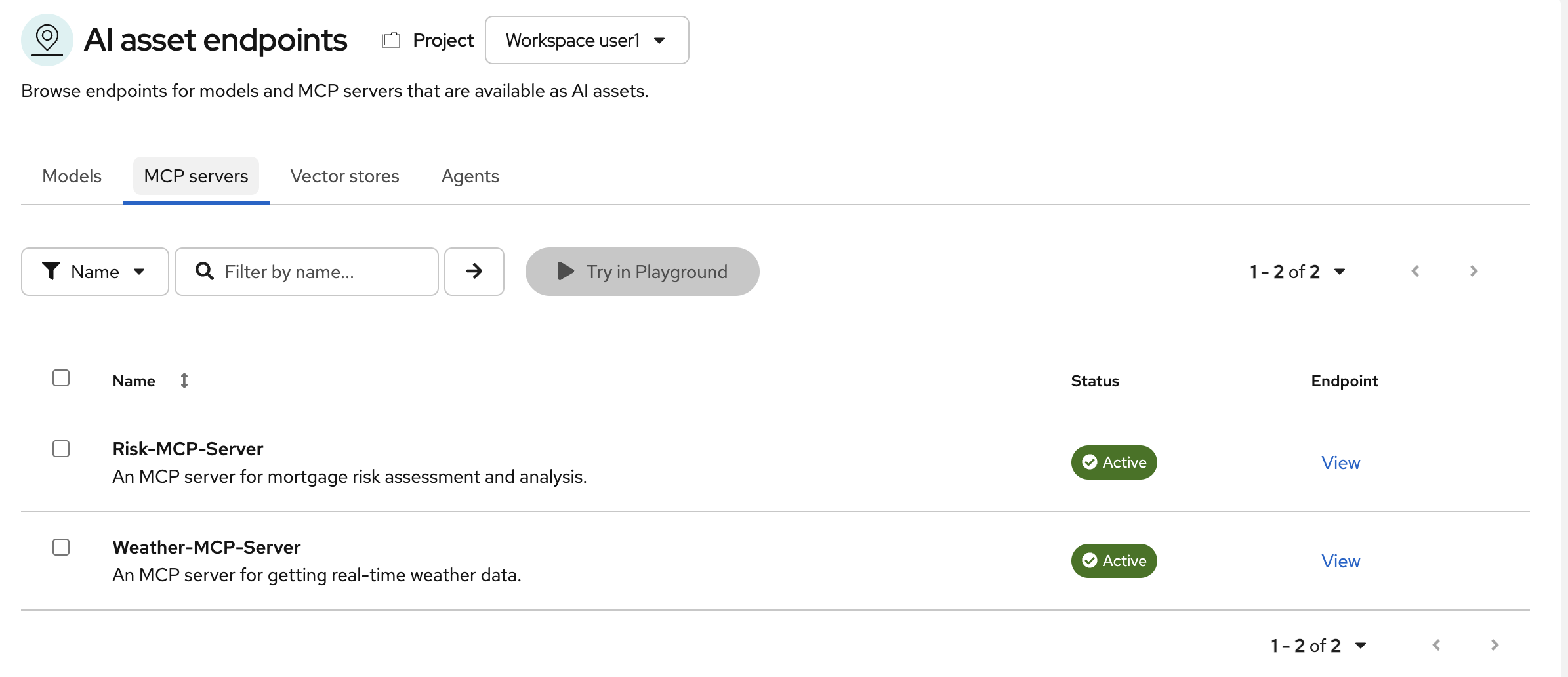
There are also already 2 MCP servers deployed in your environment. Go to AI Asset endpoints > MCP servers in order to see them. The two servers are:
-
Risk Server MCP - ML-backed loan approval prediction, provides assessments a loan officer needs to know
-
Weather MCP - provides weather and climate data, used by Lenora to flag flood risk and climate exposure for property locations
-
Exercise 4: The Risk MCP Server, With and Without Tools
The Risk Server MCP has a predictive AI model running behind one of its tools.
When Lenora calls uw_predict_loan_approval, the MCP server does not apply a rules-based formula. Instead, it passes the application metrics through a scikit-learn classification model trained on historical loan application data. That model was trained using AutoML (which you can explore in the Advanced section at the end of this section). This is how Fed Aura Capital connects classical machine learning to generative AI: the LLM orchestrates and decides what to ask, and the ML model predicts.
The Risk Server exposes four tools:
| Tool | What it does |
|---|---|
|
Calculates debt-to-income ratio from monthly income and total debt obligations |
|
Verifies that the applicant’s cash reserves meet the minimum threshold for the loan type |
|
Passes application metrics through the AutoML model to produce an approval prediction |
|
Synthesizes the outputs of the other tools into a structured recommendation |
The difference between a chatbot and an agent is not the model. It is tool access. Let’s see that difference directly by sending the same prompt with and without the Risk Server connected.
Without MCP
-
Go to Gen AI Studio > Playground. If you don’t have any playground yet, create a new one with the
qwen3-235b-a22bmodel. If you already have one, you can continue using it. -
Currently there isn’t any MCP tools connected. Send the below prompt:
I have a client earning $8,000/month with $2,400 in monthly debts. What's their debt-to-income ratio and is it acceptable for a conventional mortgage? -
Observe the response. The model calculates DTI from the numbers you gave (30%) but hedges: "this is generally considered acceptable, but you should verify with your specific underwriting guidelines." It is doing arithmetic from the prompt. There is no tool call, no lookup against Fed Aura Capital’s actual thresholds, and no certainty.
With MCP
-
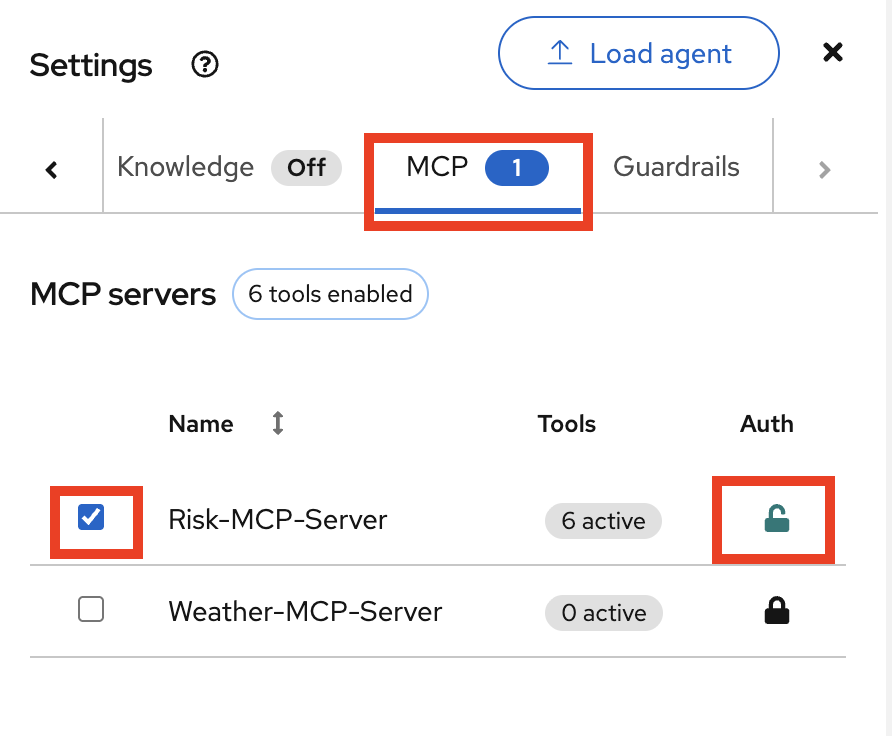
Under Settings > MCP, connect to the Risk Server MCP by clicking the lock icon 🔒 under Auth and click Save. Then check the box to enable the Risk Server MCP for this Playground.:
-
Send the exact same prompt again.
-
Observe the difference. The model now calls
calculate_dti, returns values grounded in Fed Aura Capital’s underwriting rules, and gives a clear assessment (acceptable or not) without hedging: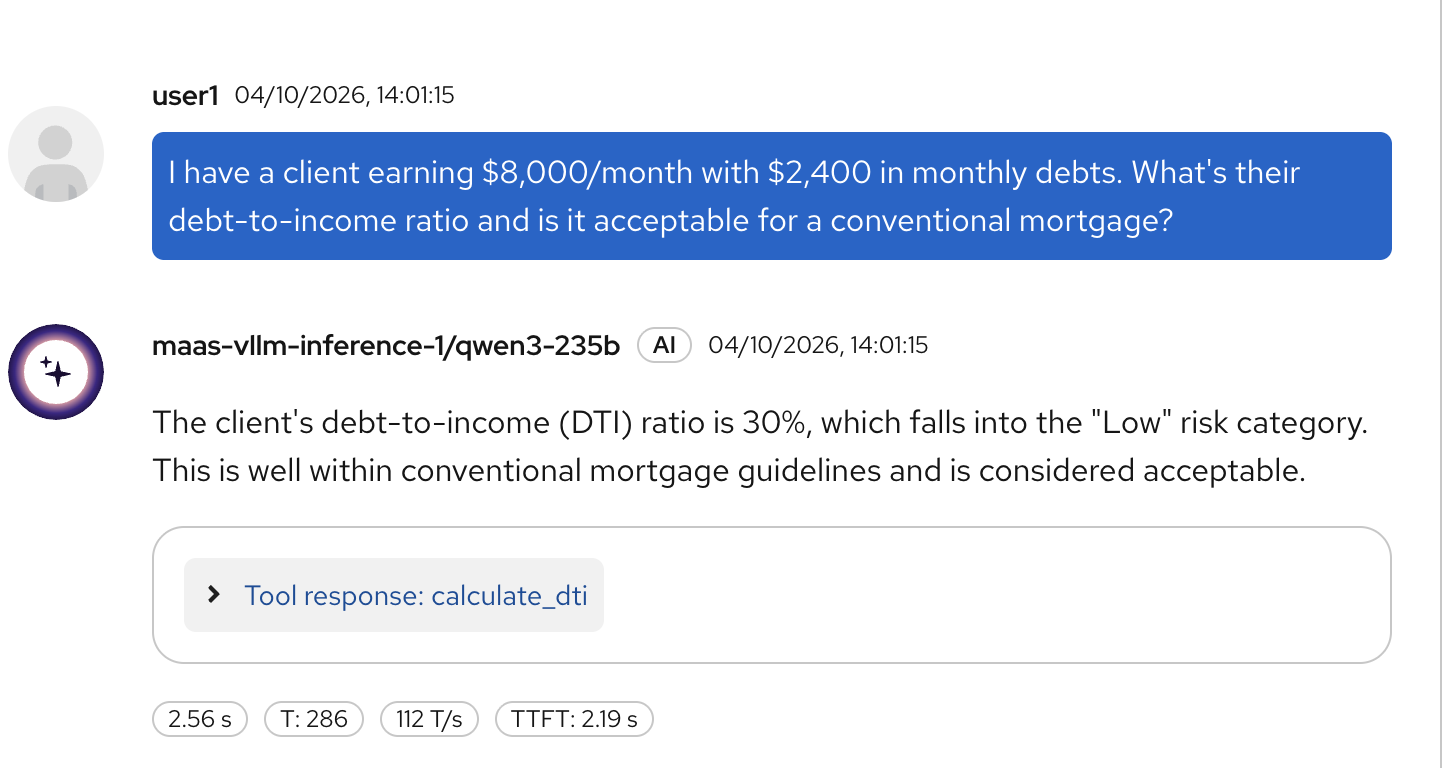
| Dimension | Without MCP | With MCP |
|---|---|---|
Answer precision |
Estimated from prompt arithmetic |
Calculated by |
Source of truth |
Model training data |
Fed Aura Capital’s underwriting rules |
Tool calls |
None |
|
Hedge language |
"verify with your guidelines" |
Clear pass/fail against defined thresholds |
| The question was identical. The model was identical. The only difference was whether Lenora had tool access. This is why MCP matters: it is not about making the model smarter; it is about giving it access to real systems with real data. |
What’s Next?
Lenora can call tools and deliver precise, grounded answers. But how do you know those answers are correct across the full range of questions she might face? How do you catch a regression when someone edits the system prompt? That is what continuous evaluation provides. In the next section, you will run model capability benchmarks, evaluate RAG quality, and use an LLM to judge Lenora’s own responses.