From Idea to Production
You joined Fed Aura Capital as a new engineer and watched the CTO’s briefing. Lenora had started as a chatbot connected to an external API: a promising way to make mortgage lending easier, but one that raised questions about data, accuracy, access, and accountability.
The workshop followed the team’s response. Each phase supplied something the prototype needed to become a service the business could operate.
From a conversation to a business capability
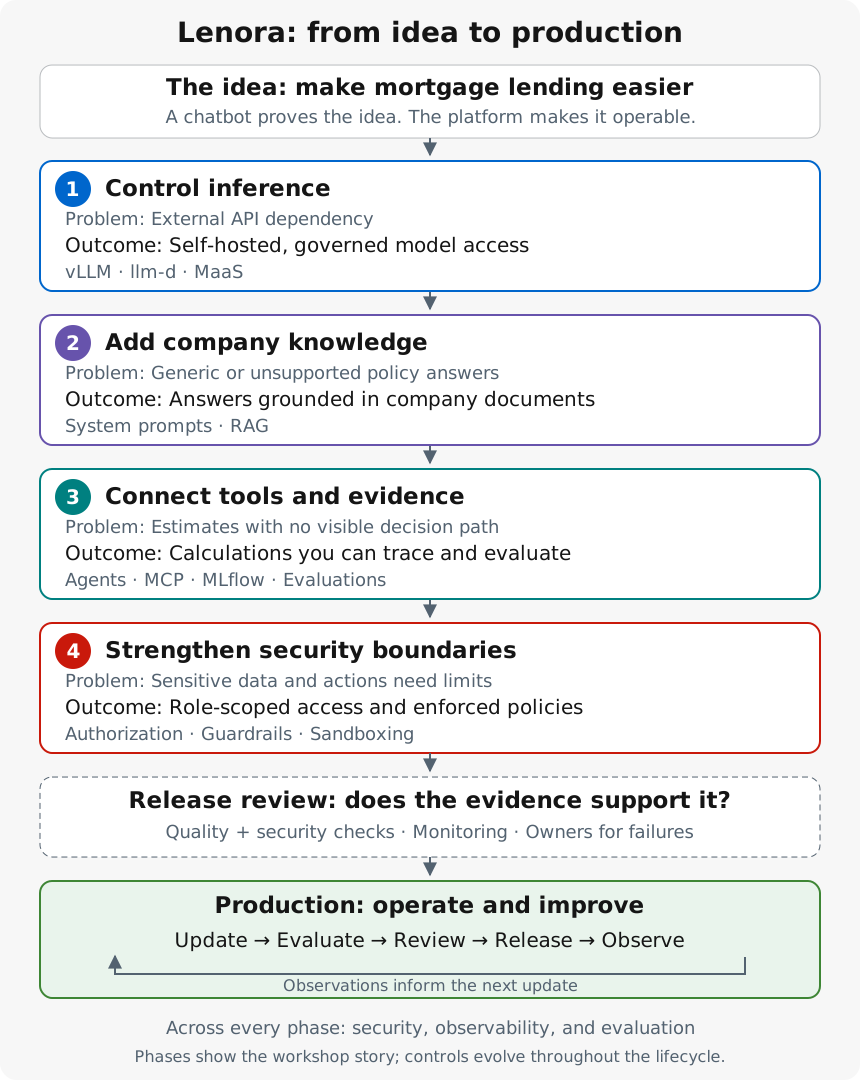
First, take control of inference. Every borrower question once depended on an external API. Self-hosted inference and MaaS gave the team control over where requests were served and how teams accessed the model.
Then, give the assistant company knowledge. A fluent answer could still quote the wrong policy. RAG supplied facts from private documents, while the versioned system prompt defined Lenora’s behavior. Your repeated product question made the change visible: the answer became specific to Fed Aura Capital.
Next, connect knowledge to action. An underwriter needed an assessment of an actual application. Agents used MCP tools to retrieve its data and calculate risk inputs. Traces exposed the work behind the answer; evaluations gave the team a way to detect regressions when that work changed.
Finally, strengthen the boundaries. The CEO and a public visitor could ask the same question but were entitled to different information. Authorization and guardrails addressed access and interaction risks. The separate OpenShell exercise showed why a coding agent also needs limits on its runtime actions.
These were the CTO’s four phases of investment. Security, observability, and evaluation remain responsibilities throughout the lifecycle, including the next change.
The whole platform, one more time
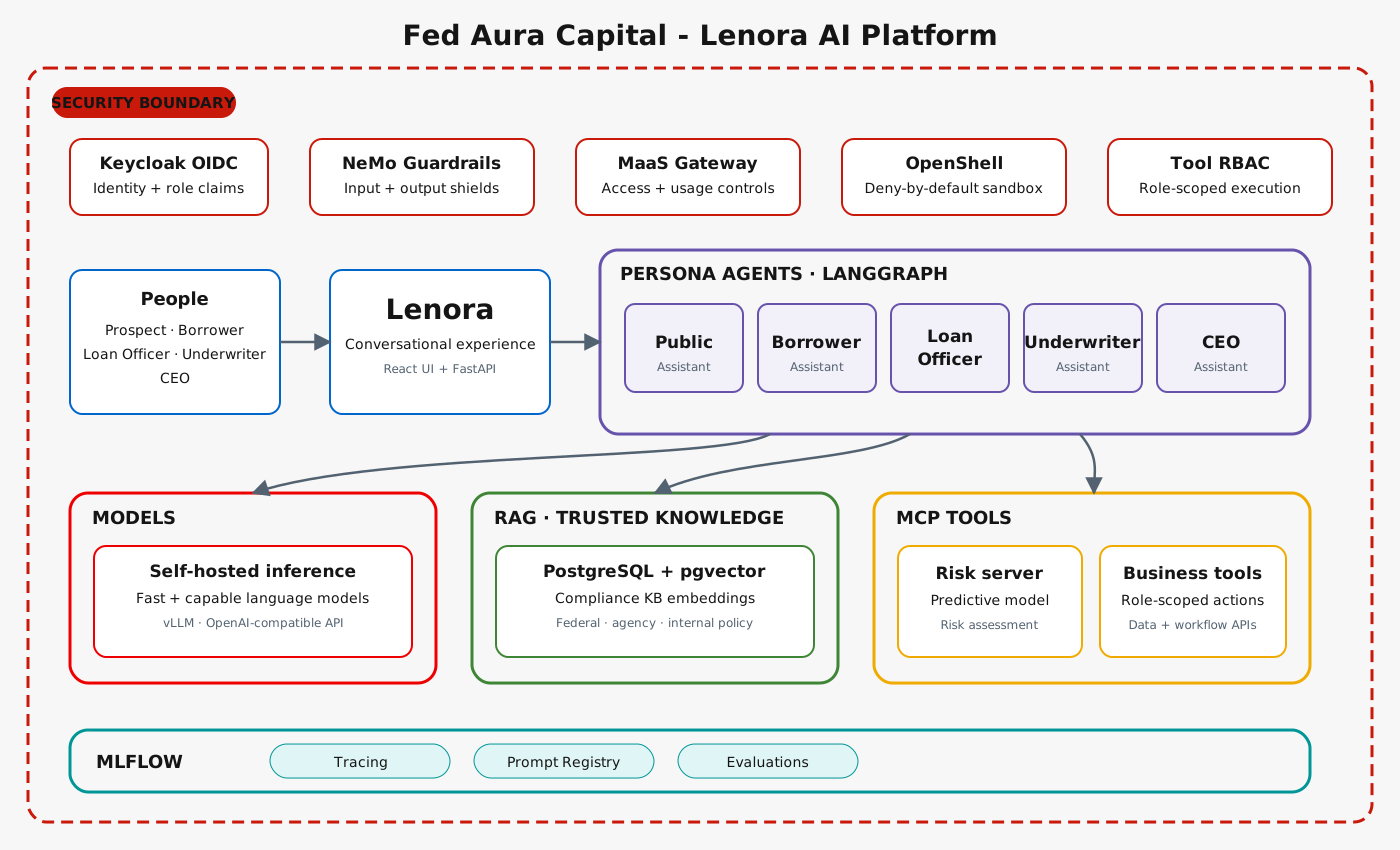
At the beginning, this diagram was a map of unfamiliar components. Now you can connect each part to a question you asked, a tool you called, or a control you tested.
Imagine the Underwriter asking again:
Run a risk assessment on application #196.
This time, you can explain what sits behind the chat window:
-
Identity and authorization establish access. The authenticated persona determines which agent and business tools are available.
-
The model and prompt guide the work. The agent uses governed inference and its configured instructions to decide what to request next.
-
Knowledge and tools supply evidence. When policy context is needed, RAG retrieves relevant passages. Tools retrieve the application record and calculate the assessment inputs.
-
Safety controls check the interaction. Input and output shields apply their configured checks, while tool authorization constrains execution.
-
Traces make the result inspectable. MLflow records the steps so an engineer can investigate a wrong answer, a failed call, or unexpected latency.
OpenShell adds a runtime boundary for the coding agent you explored. Evaluation sits alongside these live interactions: it tests whether changes preserve the behavior the team expects before those changes are released.
The Underwriter sees an assessment to review. You can explain where its inputs came from, which tools ran, and which controls applied. That is the difference the platform makes.
Production keeps the story moving
The next policy update starts the cycle again: update the knowledge source, evaluate answer quality, review access and safety checks, then release the change. Traces and usage data reveal what needs attention afterward.
The workshop demonstrated the building blocks and selected checks. A production release brings them together with validation for the organization’s own workloads and policies, monitoring, and a clear owner for failures. The same discipline applies when a model, prompt, or tool changes.
Your next chapter
Choose a use case in your own organization and ask four questions:
-
Who will use it, and what work should it help them complete?
-
Which private knowledge and live tools does it need?
-
What may each user and agent access or change?
-
Which evaluations and traces would show that it works?
Return to the CTO’s original questions: where does the data go, whose knowledge informs the answer, what can the agent do, and how can the team investigate it? You now know where to look for each answer. That is what it means to support Lenora beyond the prototype.