Introduction
Build the integration flows that connect Matrix and Rocket.Chat through Apache Kafka — creating a decoupled, event-driven architecture ready to welcome new systems.
Quick reminder
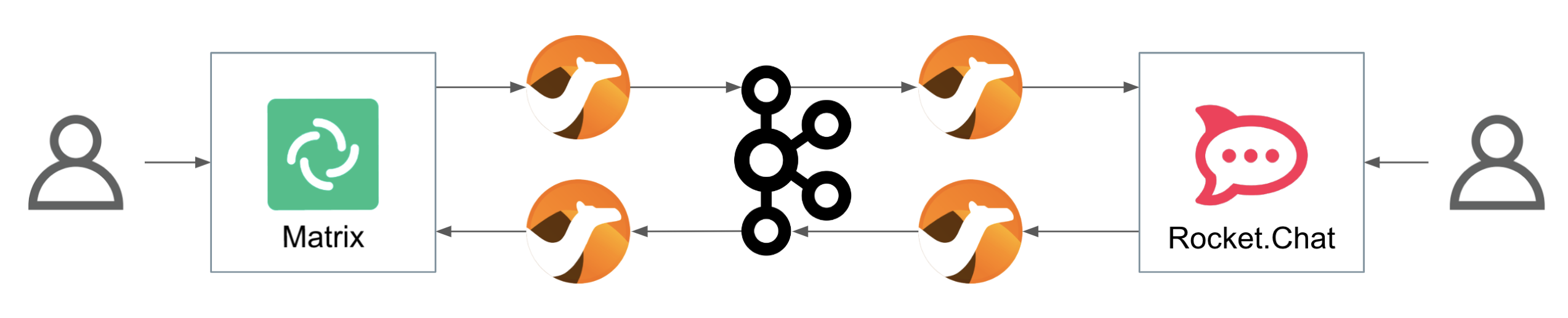
Customers reach out about their Policy Applications through Matrix, while support agents respond from Rocket.Chat. The goal is to bridge both platforms so messages flow seamlessly between them.
Why Kafka in the middle?
Rather than connecting Matrix and Rocket.Chat directly to each other, we place Kafka between them as a streaming backbone. This decouples the two platforms — neither needs to know about the other. Each system simply publishes and consumes messages through Kafka.
Why does this matter? Because it opens the architecture. Any new system — a helpdesk tool, a notification service, an AI agent — can plug into the same Kafka topics without touching the existing flows.
A common data model
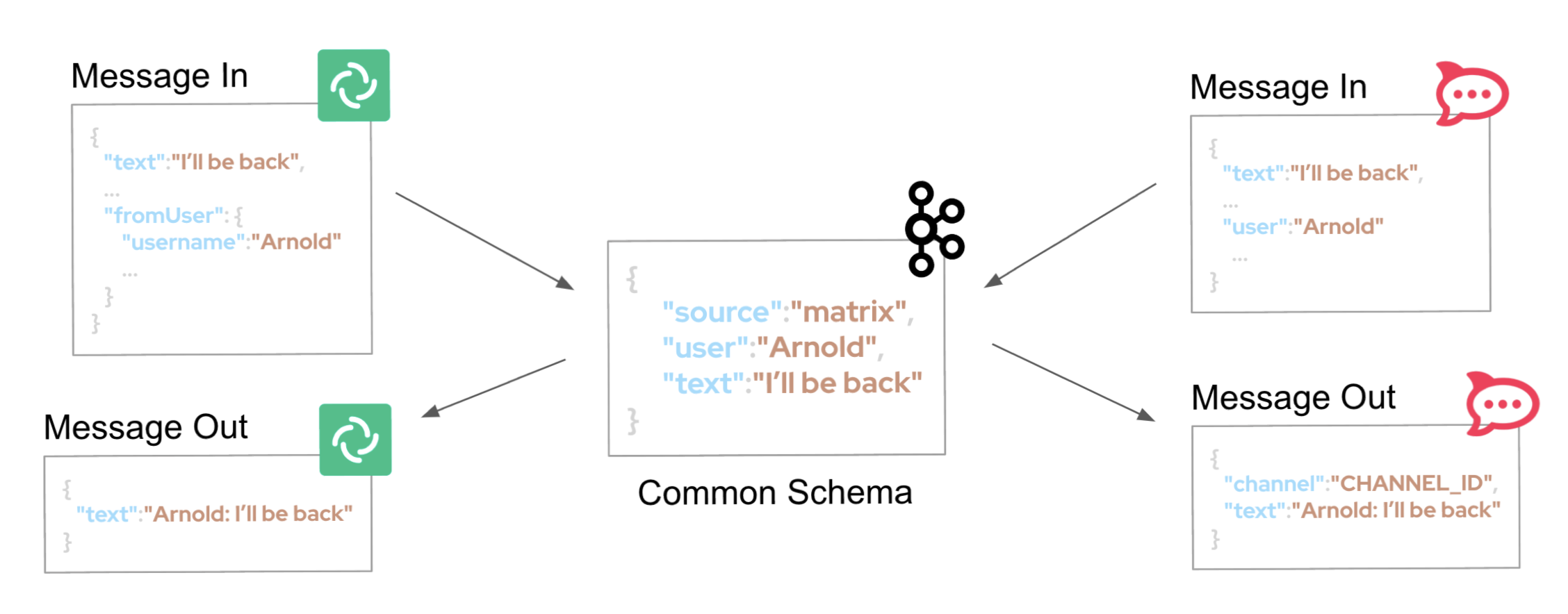
For this to work cleanly, we adopt a standard data model as the common language on Kafka. Instead of translating directly between platform-specific formats (Matrix to Rocket.Chat), each flow transforms in two steps:
-
Inbound: platform-specific format → standard data model (into Kafka)
-
Outbound: standard data model → platform-specific format (from Kafka)
This means every system integrates with one common interface, not with every other system individually.
Four flows, one pattern
To bridge Matrix and Rocket.Chat bidirectionally through Kafka, we need four distinct flows:
-
Matrix → Kafka
-
Kafka → Rocket.Chat
-
Rocket.Chat → Kafka
-
Kafka → Matrix
| This may seem like more work than a direct connection, but the pattern is the same across all four. In this lab we’ll focus on building one of them — the rest follow the same approach and will be enabled at the end. |